

Perfect competition is a theoretical market structure in economics where certain conditions are met, leading to an ideal level of competition. In this market, no single buyer or seller has control over prices, and all firms operate efficiently with free entry and exit.
A perfectly competitive market structure has the following six assumptions –
- Price Taker (due to large numbers of buyers and sellers)
- Product Homogeneity
- Free Entry & Exit
- Perfect Information
- Perfect Mobility of Factors of Production
- No Government or External Intervention
Price Taker : When large number of firms compete in a market, each firm faces a significant number of direct competitors for its products. As each firm sells a very small portion of the total market output, its decisions have no impact on market price. Thus, each firm takes the market price as given. If a firm doesn’t offer a competitive price then consumers will definitely buy from other sellers. In short, firms in perfectly competitive markets are price takers.
Product Homogeneity : Price taking behaviour typically exists in markets where firms produce identical or nearly identical products. When the products of all of the firms in a market are perfectly substitutable with one another that is when we say that the products are homogeneous. This crucial assumption forbids all the firms to sell their products at the market determined price. Otherwise they will lose their customers to other firms.
Free entry & exit : The third assumption of free entry /exit implies that there are no special costs involved which makes it difficult to enter a perfectly competitive industry or even to exit if the firm cannot make profit. As a result buyers can easily switch from one seller to another.
Perfect Information:
- Buyers and sellers have complete knowledge about prices, quality, and market conditions.
- No information asymmetry exists.
Perfect Mobility of Factors of Production:
- Resources (labor, capital) can move freely between industries.
- No restrictions on shifting production inputs.
No Government or External Intervention:
- No taxes, subsidies, or regulations distort the market.
- Prices are determined purely by supply and demand.
Examples of Perfect Competition
- Agricultural markets (e.g., wheat, corn, rice)
- Foreign exchange markets (Forex)
- Stock markets (for identical shares of a company)
(Note: Perfect competition is rare in reality but serves as a benchmark for analyzing real-world markets.)
A competitive firm’s profit maximizing output :
A competitive firm’s profit maximization occurs when the selling price of the product equals the marginal cost (MC) of the output. Hence, a competitive firm will continue producing output until the point where price becomes equal to MC but will shut down if the selling price goes below the average economic cost. Now economic costs are the cost of utilizing resources in production including opportunity cost. For further details around the economic cost concept please this post. Average economic cost becomes equal to the average total cost where there are no sunk costs but becomes equal to the average variable cost there are sunk costs involved in the production process. Hence, the firm’s supply curve is that segment of the marginal cost curve for which marginal cost is greater than average economic cost.
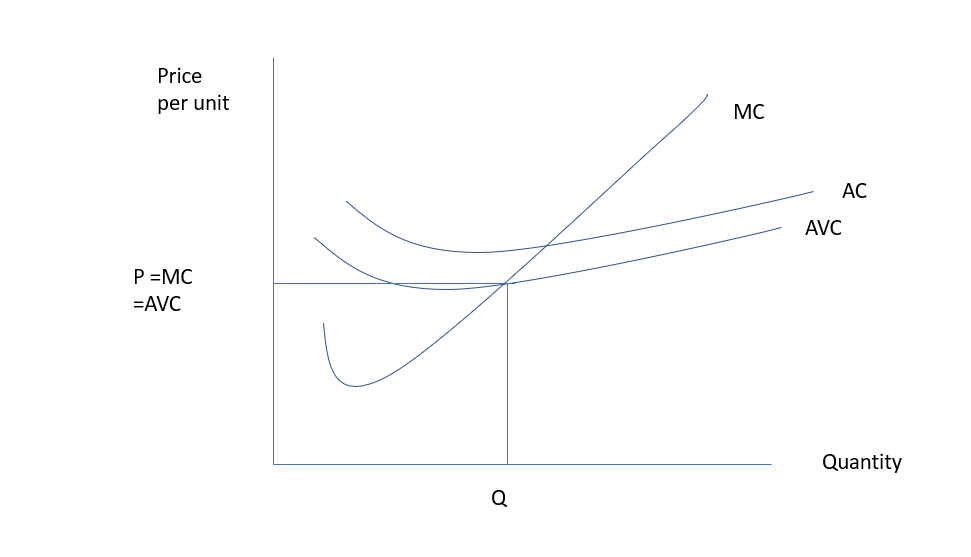
The diagram above illustrates the short run supply curve for the case in which all fixed costs are sunk costs.
Hence, Equilibrium in Perfect Competition needs the following conditions to be met:
- The market operates at productive and allocative efficiency.
- Firms produce at the point where Marginal Cost (MC) = Marginal Revenue (MR) = Price (P).
- In the long run, firms earn zero economic profit (normal profit only) due to free entry and exit.
Advantages of Perfect Competition
✔ Efficient resource allocation (no wastage)
✔ Low prices for consumers (due to competition)
✔ No monopolistic exploitation (since no single firm controls the market)
Disadvantages of Perfect Competition
✖ No innovation (since products are identical, firms have no incentive to improve)
✖ No economies of scale (firms are too small to benefit from large-scale production)
✖ Unrealistic assumptions (perfect information and no barriers rarely exist in reality)
Conclusion
Perfect competition is an idealized market structure that helps economists analyze efficiency and pricing. While real-world markets (like monopolistic competition or oligopolies) deviate from this model, understanding perfect competition provides insights into how competitive markets should function.