
The equation of an IS curve is expressed as below:
IS : Y = C(Y-T) + I(r) + G (1)
where Y is the aggregate demand, C is the consumption expenditure, I is the investment expenditure an G is the Government expenditure.
Upon breaking down each of the components separately we can see that
C ( Y -T ) = a + b ( Y – T ) (2) where ‘a‘ captures everything that affects consumer spending other than the disposable income. Here, Y-T is is the disposable income after taxes (T).
I(r) = c – dr (3) c, d >0 where c is autonomous and captures everything that affects investment spending other than interest rate and d captures the sensitivity of investment w.r.t interest rate. The negative sign implies the negative relationship between investment expenditure and interest rate.
Now replacing our primary IS equation (1) with (2) and (3), we get the following equation
Y = [ a + b(Y-T) ] +( c – dr ) + G (4)
After rearranging the equation will look like below
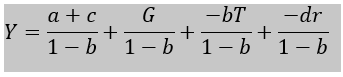
- From this above equation we can tell that as the coefficient of government purchase is positive, an increase in government purchases shifts IS curve to the right.
- Since the coefficient of taxes is negative, an increase in taxes shifts IS curve to the left.
- If investment expenditure is highly sensitive to interest rate, then ‘d’ is large and income is highly sensitive to interest rate as well. In this case, small changes in interest rate lead to large changes in income. The IS curve becomes flat. Conversely, if investment is not very sensitive to interest rate then IS curve becomes steep.
- Slope of IS curve depends on Marginal Propensity of Consume (MPC), b. The larger the MPC, the larger the change in income at a given rate of interest. The reason is that a large MPC leads to a large multiplier for changes in investment. The larger the multiplier the larger the impact of a change in investment on income and the flatter the IS curve. The MPC also determines how much changes in fiscal policy will shift the IS curve. The coefficient of G, 1/1-b is the Government expenditure multiplier. Similarly, the coefficient of T, -b/1-b is the tax multiplier. The greater the multiplier, the greater shift in the IS curve is expected.